Ways to Beat the Fuel Crisis in Business
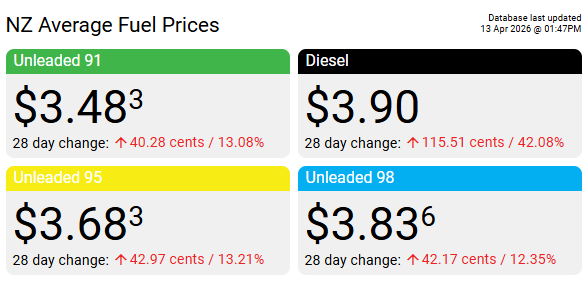
Unleaded fuel prices are up 13% and diesel prices up 42% in the past 28 days. What can businesses do to manage costs, retain profits and take care of their team?
Keep Track of Local Fuel Prices
Throughout New Zealand, fuel prices are up. Unleaded fuel prices are up 13% and diesel prices up 42% in the past 28 days to 13 April 2026 (Figure 1)[i]. That means the cost of a full tank of most NZ petrol vehicles has gone up $15 - $30; diesel by more than $50.
Sign up your business for fuel cards and bulk purchasing agreements. Most fuel outlets offer fuel cards with fixed discounts, consolidated reporting and better cashflow visibility. Some larger fleets can negotiate capped pricing or short-term fixed pricing to reduce volatility.
There can be some price variation between petrol stations. Gaspy.nz’s mobile app tracks the prices of nearly 2,500 locations in New Zealand, so you can quickly find the cheapest place to refuel in your neighbourhood.
Claim Fuel Excise Duty (FED) Refund for Equipment
If your business buys petrol, CNG or LPG for vehicles, vessels or equipment that is not driven on the road, then you may be eligible for a Fuel Excise Duty (FED) Refund. For example, fuel used in chainsaws, water blasters, commercial fishing vessels, farm bikes, irrigation pumps.
You’re entitled to a refund of the excise duty and the goods and services tax (GST) charged on fuel used:
· in an exempted vehicle
· in a road user charges-licensed vehicle
· in a commercial vessel
· for search and rescue purposes in a dedicated rescue vessel
· for commercial purposes other than as a fuel in any motor vehicle, vessel, or aircraft.
Check out NZTA for more information on eligibility[i].
You need to keep receipts and tax invoices and record usage for each vehicle, vessel or equipment that you want to claim, and lodge a claim every quarter end. If you have a bulk fuel storage tank, record how much fuel is left at the end of each quarter.
Reduce Your Travel Distances
If your business spends a lot of time on the road, then GPS Tracking and Fleet Management software is invaluable. A GPS unit the size of a USB stick or a tablet is mounted in the vehicle and sends real time data back to base. In many cases the cost savings outweighs the cost of the GPS unit. You can test this out for yourself using a ROI calculator, like this one from Argus[ii].
You can optimise scheduling and driving routes. E.g. sticking to one group of suburbs each day. This is particularly helpful for trades, couriers, home services and healthcare providers. You can improve productivity, by teams spending more time on jobs than travelling between jobs. As well as managing fuel usage, you can also track driver safety.
Cut back on in-person meetings. Can you meet your clients and team by video call? Will an email or phone call suffice?
Drive Carefully and Smoothly
If drivers accelerate and stop more smoothly, they can save fuel, even if they don’t drive shorter distances than before. Decreasing your speed from 100 km/h to 90 km/hr can save up to 7%[iii]. Steady driving, without braking hard and accelerating quickly, can save 10% on fuel. Reduce drag by removing roof racks, bike racks or cargo boxes when not in use. If you’re stopping for more than 30 seconds turn off the engine. Careful driving can also give you savings in repairs and maintenance, insurance and fewer injury days.
Keep your Fleet Well Maintained
You can reduce fuel use and improve safety by keeping your vehicles in top shape. Get your vehicles serviced regularly. Check your wheel alignment, tyre tread and tyre pressure.
Update Your Fleet
Newer vehicles are generally more fuel efficient than older models. Choose the right size for your needs. Smaller cars need less fuel. Research your options for switching away from petrol and diesel. There are lots of electric and hybrid vehicle options on the market. Read our JDW blog on the financial aspects of choosing the right vehicle[iv].
Avoid overloading or underloading vehicles. Match your vehicle type to the task, such as using utes or vans when transporting tools or equipment.
Investment Boost
If you’re buying a new vehicle or new equipment, remember there is the Investment Boost. It allows you to claim 20% of the cost as an upfront tax depreciation deduction.[v]
Managing Fuel Costs for Your Team
As employers, we can also help our team manage their personal fuel costs. When considering fuel or transport support, it’s important to balance fairness between employees who must travel to work and those who can work from home or remotely. To avoid inconsistency or unintended tax and employment issues, any fuel or travel support should be clearly documented, communicated to staff, and reviewed regularly.
Work from Home
Can your team work from home? If not full time, what about on some days of the week? Can they work at a hub closer to home? Employers can pay employees an allowance of up to $27 a week, to reimburse for home office costs and telecommunications. It is tax deductible for the employer and tax-free for the employee.
FareShare
Auckland Transport has a FareShare subsidy scheme for businesses with 5 or more employees, to encourage the use of public transport. Employer can opt to subsidise 25%, 50% or 75% of public transport fares, and whether it applies for weekdays only or all 7 days. It works for existing AT HOP card users on buses, trains and some ferries. The cost is about $23 person on average per month for a 25% subsidy.[vi] It frees up customer parking around your businesses, reduces road congestion and CO2 emission.
Public transport subsidies are now exempt from FBT, so businesses can claim a full tax deduction for paying the subsidies[vii].
Carpooling, Biking and Walking
Encourage your team to carpool if they live near each other. As well as saving fuel, they get to know each other better and form lasting friendships.
If your team live close to work, you can encourage them to bike or walk to work. Have secure bike storage on site. Provide facilities, shampoo and bodywash, so they can shower at work. Start a staff steps challenge with fun prizes to encourage walking.
Oncharging To Your Customers
Review your contracts with your customers. Are you able to include a fuel surcharge clause? If you disclose your delivery or travel costs as a separate invoice item, are they high enough to cover your costs? Can you review your pricing more often during periods of volatility? Courier costs have already been adjusted for rising fuel prices. If you’re currently offering free shipping, you may need to increase your prices or only offer free shipping for higher value sales, to ensure that your costs are recoverable.
There’s No Single Solution
There is no silver bullet for rising fuel costs. Beating the fuel crisis requires a combination of small behavioural changes, smarter operational decisions, and, in some cases, targeted investment in vehicles, technology, or systems. The most effective approach will differ from business to business, depending on industry, location, team structure, and cashflow.
Smart businesses can manage the current fuel volatility by reviewing usage regularly, involving their team in solutions, and remaining open to change as conditions evolve. By taking a proactive and balanced approach, businesses can protect profitability, support their people, and build greater resilience in the face of ongoing uncertainty.
- Serena Irving
Serena Irving is a director in JDW Chartered Accountants Limited, Ellerslie, Auckland. JDW is a professional team of qualified accountants, business consultants, tax advisors, trust and business valuation specialists.
Download a PDF version here or contact the author by email. Like our Facebook page for regular tips.
An article like this, which is general in nature, is no substitute for specific accounting and tax advice. If you want more information about the issues in this article, please contact your adviser or the author.
[i]
https://www.nzta.govt.nz/vehicles/fuel-excise-duty-refunds
[ii] https://www.argustracking.co.nz/calculate-your-savings
[iii] https://www.eeca.govt.nz/fuel
[iv] https://www.jdw.co.nz/choosing-a-vehicle-for-your-business
[v] https://jdw.co.nz/investment-boost-nz-budget-2025
[vi] https://at.govt.nz/about-us/sustainability/travelwise-for-business/about-fareshare
[vii] https://www.ird.govt.nz/employing-staff/deductions-from-other-payments/fringe-benefit-tax/types