
Moving from NZ to Australia - a tax check
Thinking about moving to Australia? Before you pack the boxes, it is worth getting clear on how the move may affect your tax position on both sides of the Tasman.
We are New Zealand tax advisers, not Australian tax advisers, so this article is not Australian tax advice. However, if you are an NZ tax client moving to Australia, there are useful issues to raise early with an Australian adviser — especially if you have investments, a business, trusts, employee shares, or property in New Zealand.

Tax residency is separate from immigration status
Your visa status and your tax residency are not the same thing. Many New Zealand citizens can live and work in Australia on a Special Category Visa, but the Australian Taxation Office still applies its own tax residency rules.
You become Australian tax resident based on several tests:
· Domicile test – domicile by origin, choice or law, permanent place of abode.
· Resides test – physical presence, living arrangements, family, business/employment and social ties.
· 183-day test – if you’re in Australia for more than half the income year, unless your usual place of abode is outside Australia and you have no intention of taking up residency in Australia.
· Superannuation test – you are a contributing member of the Public Sector Superannuation scheme or the Commonwealth Superannuation scheme.
You may also remain a New Zealand tax resident for a period after you leave, particularly if you still have a permanent place of abode in New Zealand. In some cases, you may need to consider whether you are tax resident in both countries. The New Zealand–Australia double tax agreement helps determine where you are treated as tax resident.
Temporary resident status can be important
Some New Zealanders living in Australia may be treated as temporary residents for Australian tax purposes. Temporary resident status can apply for many years, provided neither they nor their spouse has applied for Australian permanent residency or taken Australian citizenship.
If you remain a New Zealand tax resident after you leave, New Zealand may continue to tax you on your worldwide income until you cease NZ tax residency or the double tax agreement treats you as resident only in Australia. This is one reason it is important to get advice before assuming your NZ filing obligations stop when you move.
If temporary residency applies, Australia may tax them mainly on Australian-sourced income, rather than most foreign income and gains. This can be helpful if you keep NZ bank accounts, shares, rental property, business interests, or other investments. The rules are technical and depend on your circumstances, so this is something to confirm with an Australian tax adviser before you rely on it.
Disclosing worldwide income in an Australian tax return
When you become tax resident in Australia, you must disclose all worldwide income earned from that date. This might include wages and salaries, interest, dividends, foreign pensions, rent from investment properties, disposals of foreign assets, proceeds from employee share schemes, and beneficiary distributions from trusts. The Australian income tax return period runs from 1 July to 30 June.
If you have paid overseas tax, such as NZ withholding tax on interest, you may be able to claim a foreign income tax offset. This is a credit against your Australian tax liability for tax paid overseas, and is intended to help reduce double taxation. However, some tax credits are not claimable in Australia, such as NZ imputation credits on dividends. Similarly, in New Zealand, we can’t claim Australian franking credits.
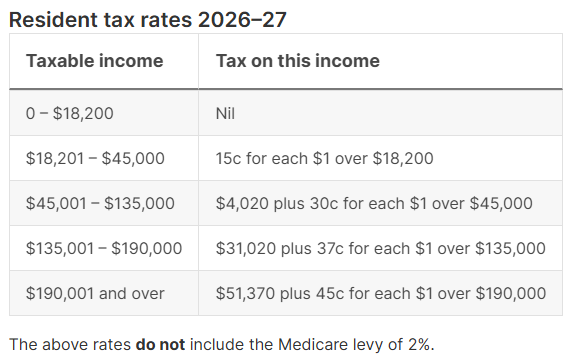
Australian resident tax rates are shown in the table below. For the 2026/2027 tax year, the rate for people earning between $18,201 and $45,000 has dropped from 16% to 15%.
Capital gains tax may be new territory
Australia has a capital gains tax regime, which can be unfamiliar for many New Zealand taxpayers. When a person becomes an Australian tax resident, the Australian cost base for some assets may be set at market value at that time, depending on their residency status and the type of asset.
If you own property, shares, business interests, employee share scheme rights, cryptocurrency, or valuable personal assets, it is sensible to get advice before you move. In some cases, timing and valuations can make a real difference.
Income and assets to review before you leave
Before leaving New Zealand, review whether you will still have NZ income or assets, such as salary, contracting income, rental property, investments, company shares, trusts, or PIE funds. You should also check whether you need to file a final or part-year New Zealand tax return, update Inland Revenue, change withholding tax settings from RWT to NRWT, and keep records of your travel dates, as these will be relevant when determining tax residency.
Our practical suggestion
If you are moving to Australia, speak with both your New Zealand adviser and an Australian tax adviser before you go. We can help you work through your New Zealand position and identify the questions to ask in Australia. For Australian-specific advice, we can refer you to an adviser in our network.
- Serena Irving
Serena Irving is a director in JDW Chartered Accountants Limited, Ellerslie, Auckland. JDW provides accounting, tax, business advisory, trust and business valuation services. JDW does not provide Australian tax advice, except in general terms, but can refer clients to Australian tax advisers where specific advice is needed.
Download a PDF version here or contact the author by email . Like our Facebook page for regular tips.
This article is general in nature and is not a substitute for advice specific to your circumstances. If you are planning a move to Australia, please contact your adviser before making decisions.