Ikigai for Business
When I was made redundant 6 years ago, I made a mind map of “What’s Next?”. I listed several options on the page, then evaluated my options. I was looking for something I was good at, I had a passion for, and what the world needed and would pay me for. I had stumbled into Ikigai, a Japanese philosophy for finding your life purpose.
What is Ikigai?
Ikigai is an ancient Japanese philosophy, with four overlapping circles. It was brought to the wider world by authors Héctor García and Francesc Miralles, who researched the Japanese village Ogimi, which has the highest percentage of residents aged over 100[i]. They found that the villagers’ secret to long and happy lives was to have a strong sense of life purpose.
[i] “Ikigai: The Japanese Secret to a Long and Happy Life” by Héctor García and Francesc Miralles 2017
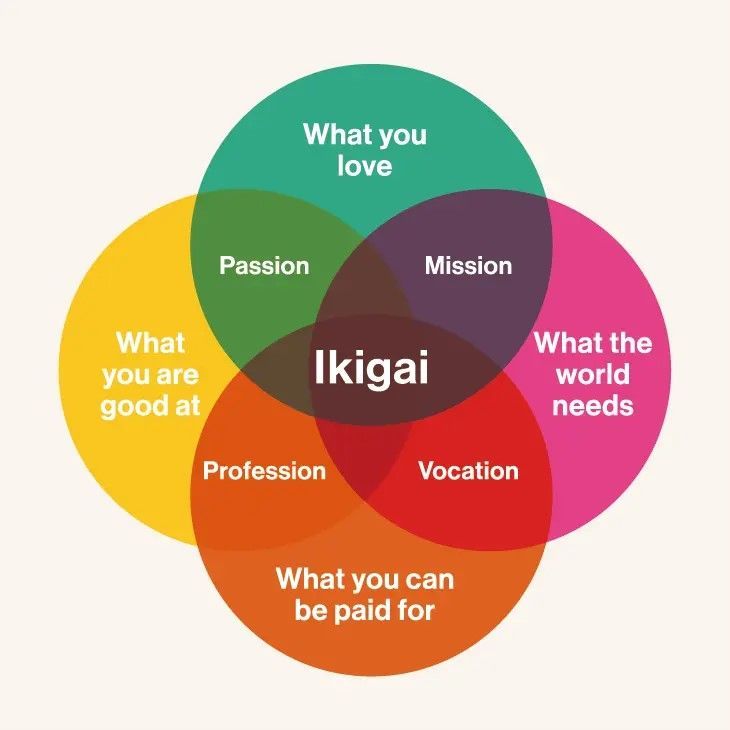
It is interesting to notice the intersections of two of the four circles.
- Passion – what you love and what you are good at.
- Profession – what you are good at and what you can be paid for.
- Vocation – what you can be paid for and what the world needs.
- Mission – what the world needs and what you love.
Ikigai involves all four circles, what you love, what you are good at, what the world needs and what you can be paid for.
If you have a strong sense of life purpose then you are more likely to remain active, maintain physical and mental health, be happier and live longer. If you don’t feel fulfilled right now, you can look at the diagram and consider, what is missing?
How Does Ikigai Work in Business?
Business owners should look for a purpose beyond profit and be able to communicate that purpose to their teams and customers. Imagine employees who are motivated and engaged by their organisation’s purpose. They will continuously find ways to improve what and how they do their work, because they are crystal clear on their why. You should encourage feedback loops and open communication to allow your teams to feel supported and empowered to make decisions.
Simon Sinek describes a Golden Circle for inspiring your organization, with Why at the centre, then How and What in circles around it.[ii] If you get your Why right, then the How and What just fall into place.
Write your purpose statement and display it prominently at work. Discuss and refine it with the team. Start with a basic “We help our customers/stakeholders {solve this problem/have a positive impact} by {what skills/mindsets/resources you bring}.” You can add, “We are passionate about this purpose, because {reason}.”
If you’re not clear on your business purpose, then there are good chances that people are just turning up for a vocation or profession. They will join the dots, get paid and go home. But if you can ignite their passion for what they do, they will move mountains. Everybody Eats is a social enterprise, “feeding bellies not bins”. Diners pay what they can afford, even if its nothing. Food is sourced by Kiwiharvest food rescue charity, who collect imperfect foods before they are wasted.
Profit isn’t a dirty word either. Imagine your business pursuing an objective, like making groceries more affordable for New Zealand families. You still need to replenish your stock, invest in better people and equipment. Profit, cashflow and investment help you do that.
Conclusion
Look for purpose beyond profit for your organisation. What does the world need from your business? What does your business love and care passionately about? What is your business good at? What can you be paid for? What can you change today, to get closer to your business Ikigai?
- Serena Irving
Serena Irving is a director in JDW Chartered Accountants Limited, Ellerslie, Auckland. JDW is a professional team of qualified accountants, auditors, business consultants, tax advisors, trust and business valuation specialists.
Download a PDF version here or contact the author by email. Like our Facebook page for regular tips.
An article like this, which is general in nature, is no substitute for specific accounting and tax advice. If you want more information about the issues in this article, please contact your business adviser or the author.
[ii] “Start with why -- how great leaders inspire action” Simon Sinek TEDxPugetSound, TEDTalk video